
Video clips
Two different video clips of the drop pinch off process recorded with a high speed camera running at several thousand frames per second. When watching through them keep in mind that the whole process took less than a second. Play through them at normal speed, then go back and lower the playback speed (controls are accessed via the three dots in the lower right corner of the frame) and slowly watch the process. The first video is of a water drop. The second is pure glycerin. Although both are fluids, the details of how they breakup provide insights into the differences in their properties.
| Water droplet | Glycerine droplet |
Images captured one at a time using a digital camera
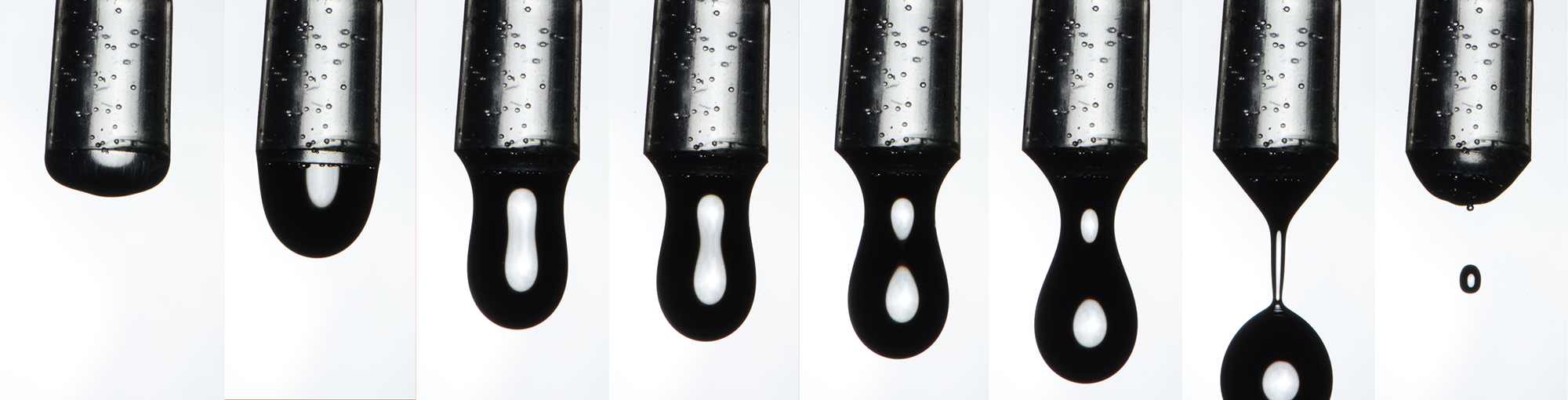
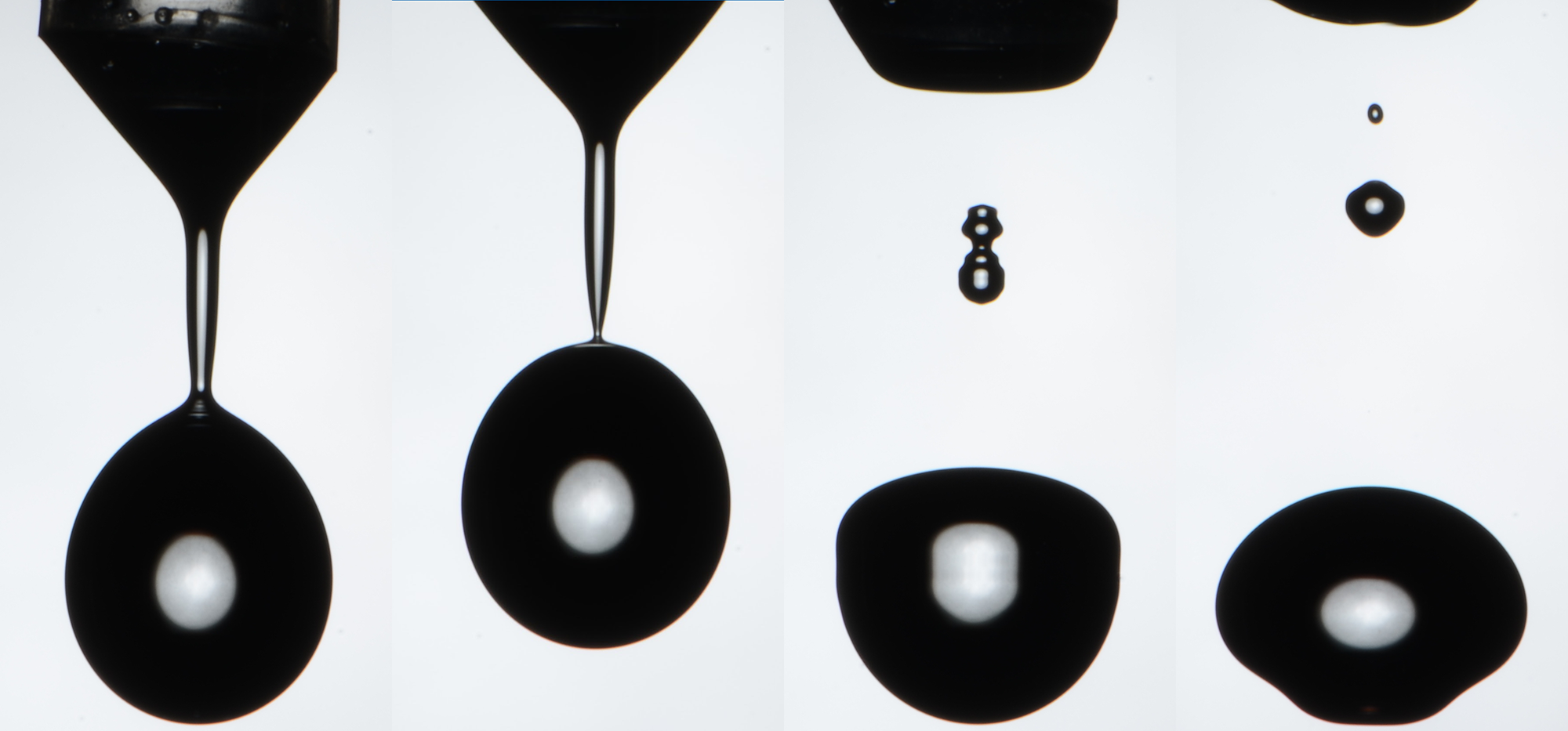
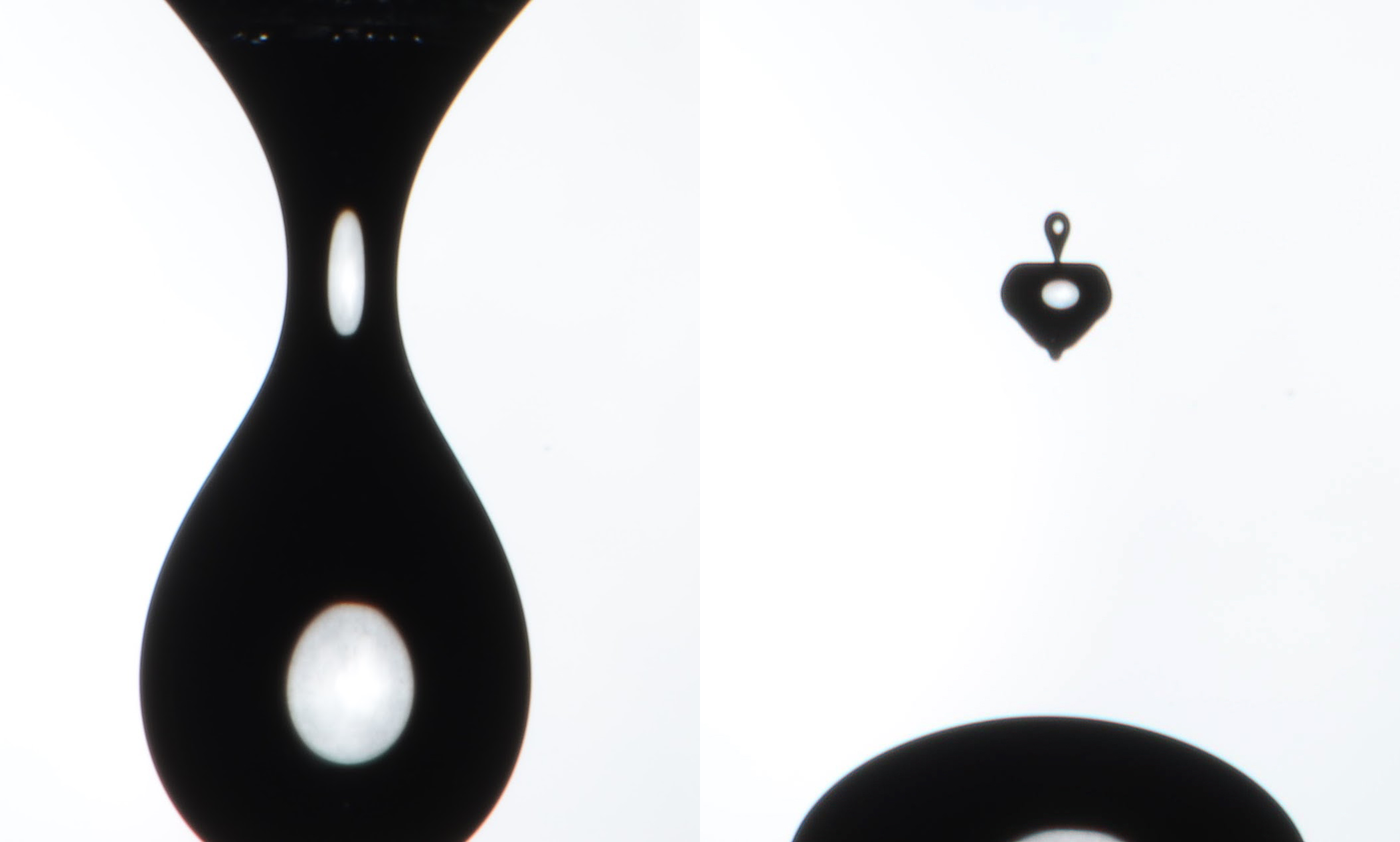
Now that you have hopefully spent some time observing the phenomena lets ask a few questions to get the scientific process started. Did you notice the following in the videos and images:
- The neck connecting the drop to the faucet exhibits at least two different characteristic shapes. Inward curving like a dumbbell in the early stages, and a much thinner, longer cylindrical shape closer to pinchoff. Strong curvature is indicative of surface tension effects while long and straight strands are more likely dominated by viscosity.
- There are different time scales apparent in the videos. The early part of the development is slower than what happens at pinch off. And what about the transitions between the viscosity and surface tension shapes, do these happen quickly or slowly.
- After pinch-off the remaining strand of fluid from the long thin neck forms back into a drop. Did you notice that the shape of this drop oscillates with a characteristic frequency.
- The behavior of the water drop and the glycerin drop are markedly different in terms of how the neck develops. Viscosity and density are two of the primary characteristics of these fluids which are very different from one another.
Fluids are incredibly complicated systems to study in rigorous mathematical detail. Fluids are made up of loosely interacting molecules. But you are not going to get very far if you attempt to model the system using quantum mechanics at the molecular scale. You could instead approach the problem using a macroscopic description of the forces and momenta involved which works well with solids such as bricks sliding down inclined planes. However these are fluids and their boundaries are constantly changing which means that quantities such as internal forces, velocities, etc. are not only position dependent within the fluid but are also changing in time in a position dependent manner. This makes it nearly impossible to find closed form solutions to the equations of motion describing the system as a whole.
How then do we study such phenomena if we cannot write down precise equations? One way is to approach the problem computationally, which is a valuable tool. But it is time consuming and tends to focus on very specific conditions. We will use a more general approach which can be highly suitable for initial investigations in to complex phenomena as a way to gain insight into the dominant physics at work and how it changes through out the process.
By watching how the drop pinch-off process evolves using high speed photography and video techniques, and using our physics intuition we have identified that the physical properties of surface tension, viscosity and density are likely to be involved. We also see reasons to expect that the influence of these factors change as a function of time relative to the moment pinch-off occurs.
(Unless otherwise specified all images and movies of drops are courtesy of Mark Chantell, University of Chicago.)